
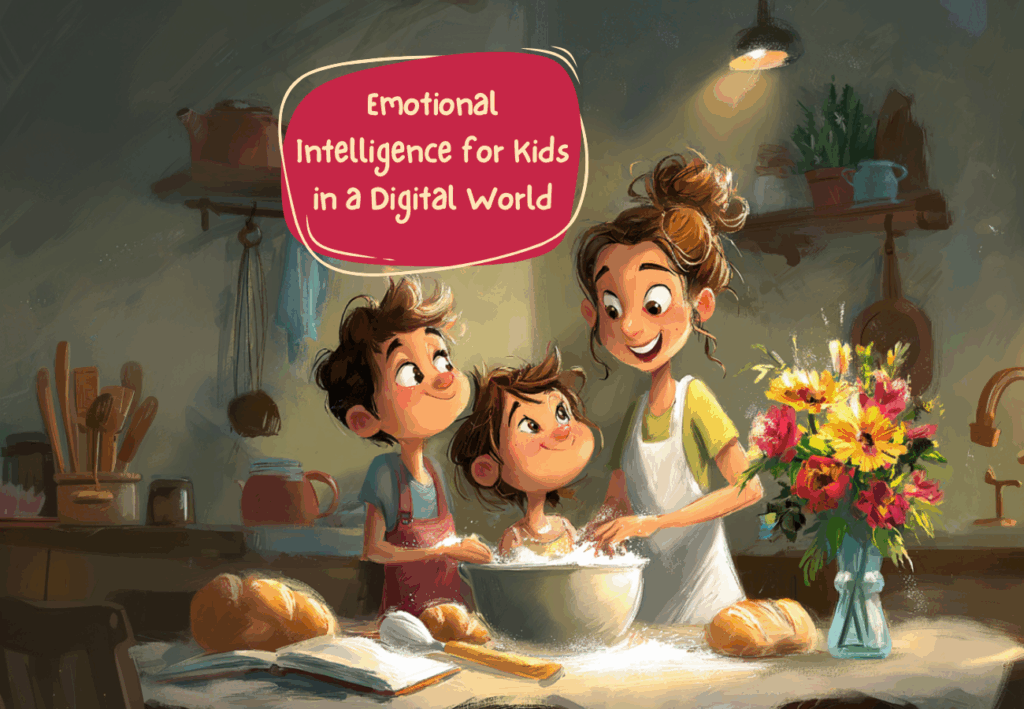
Raising children today is nothing like it was in the 90s. Children in the 90s spent the majority of their time playing outdoors with neighbors or going to the local library or the beach. In that era, screen time mostly centered around TV, cable, or video games.
But things are quite different in 2025. Kids are surrounded by screens, messages, and constant notifications.
Technology offers incredible benefits, such as access to learning tools, entertainment, and creative outlets.
On the other side of the coin, it hinders emotional growth. An article published in News-MedicalNet confirms this. It states that children who were more often given devices to cope with negative emotions showed less emotional self-control later on. That’s why nurturing emotional strength in the digital age is so important.
Here, we’ll share how you can nurture your child’s emotional intelligence in a world dominated by screens.
#1 Model the Emotional Skills You Want to See
The most impactful way to teach a child emotional intelligence is to model it yourself.
Children are observant. They learn how to manage their feelings and handle social situations by watching the adults in their lives.
An article published in Frontiers for Young Minds found that children are better at regulating their emotions when their parents use more strategies to manage their own emotions.
Your behavior, both in person and in your own use of technology, sets a critical emotional standard for your children. They not only mimic your actions, but also learn important lessons about how to experience and resolve an emotional event.
Part of this process involves deconstructing and verbalizing emotions. It is not enough for you to simply stay calm in a difficult moment. Rather, you must actively name your feelings out loud to teach children that all emotions are normal and manageable.
More than just talking it out, apologizing teaches a deep and meaningful lesson. When you lose your temper or make a mistake, apologizing sincerely teaches accountability and self-awareness.
#3 Set Healthy Screen Boundaries With Social Media Use
Social media can mess with a developing brain’s understanding of emotions and relationships.
Researchers of a study published in JAMA Pediatrics found that kids who frequently check social media experienced changes in the brain’s social reward and punishment centers.
More than any other platform, Instagram is influencing children’s brains. One study revealed that excessive social media use can lead to mental health issues like depression, loneliness, and anxiety in adolescents.
This concern is so real that teen mental health and Instagram litigation have come into the limelight for the wrong reasons.
According to TruLaw, these suits filed against Meta argue that the company intentionally designed features to maximize user engagement, specifically through social comparison. They further allege that the company did this even after knowing the potential harm to users’ mental health.
While the courts figure that out, you can teach your child to use these platforms mindfully.
Explain that people usually only share their highlight reels, not their struggles. When your teen sees everyone else looking perfect online, remind them that real life includes bad hair days, failed tests, and awkward moments for everyone.
Establish tech-free times and spaces in your home. This helps kids learn that they can survive without constant digital stimulation. Help them identify which accounts make them feel good about themselves and which ones don’t.
#3 Encourage Real Connections
Online chats and messages can’t replace real-life connections.
When kids spend too much time communicating through screens, they can miss out on learning nonverbal cues like body language and facial expressions. These are a big part of emotional intelligence.
Rather than focusing on strict time limits, crowd back into essential offline activities that are vital for a child’s development.
The American Academy of Pediatrics suggests that rules focused on balance, content, and co-viewing are more beneficial for a child’s well-being. This is more effective than rules that only focus on the amount of time spent on screens.
Something as simple as a game night can naturally foster teamwork, sharing, and communication. Classic games like UNO or Go Fish are great for younger kids. They teach turn-taking and focus.
Board games like Candyland or Jenga also promote social interaction and problem-solving skills. These activities are not passive. They require children to engage with others directly.
A Little Effort Goes a Long Way
Banning screens or going completely tech-free is an unrealistic way to nurture emotional intelligence in kids in the digital age. Instead, the goal should be to teach balance and build resilience, so they can thrive in a world where technology is part of everyday life.
Follow these tips, and you’ll help your children develop skills that will serve them for a lifetime. Eventually, your children can grow into empathetic and emotionally strong individuals who know how to navigate the digital world without losing touch with what matters. That is, human connection, understanding, and compassion.
Building this support network takes time, effort, and planning, but the benefits are immeasurable. Children who grow up with strong support networks are more resilient, confident, and successful in all areas of life. Parents who have comprehensive support systems are less stressed, more confident, and better able to enjoy the parenting journey.

More articles

10 Best Social-Emotional Learning Books for Kids (Used by Teachers & Parents)
Ask any teacher what’s changed most in classrooms over the past decade, and you’ll hear the same answer: kids need more than academics. They need to know how to handle frustration without melting down, how to include someone who’s been left out, how to say “I’m sorry” and mean it. Social-emotional learning isn’t a trend […]
How Teachers Can Use Storybooks to Build Social Skills in the Classroom
Every teacher knows the moment. Two kids arguing over a pencil, and suddenly the whole lesson is derailed. Or a child sitting alone at lunch because no one thought to include them. These aren’t dramatic crises — they’re the small, everyday moments where social skills either show up or don’t. And yet, teaching those skills […]
Why an LCSW is the Ideal Partner for Your Child’s Mental Health Journey
Navigating the emotional and behavioral challenges of a child can feel overwhelming for many parents. It is often difficult to understand what is truly behind a child’s anxiety, mood changes, or behavioral reactions, especially when different explanations and opinions come from various specialists or systems. Many families experience a fragmented approach where a child’s difficulties […]