Reading Goals for Kids: 50 Fun Reading Challenges to Build Lifelong Readers

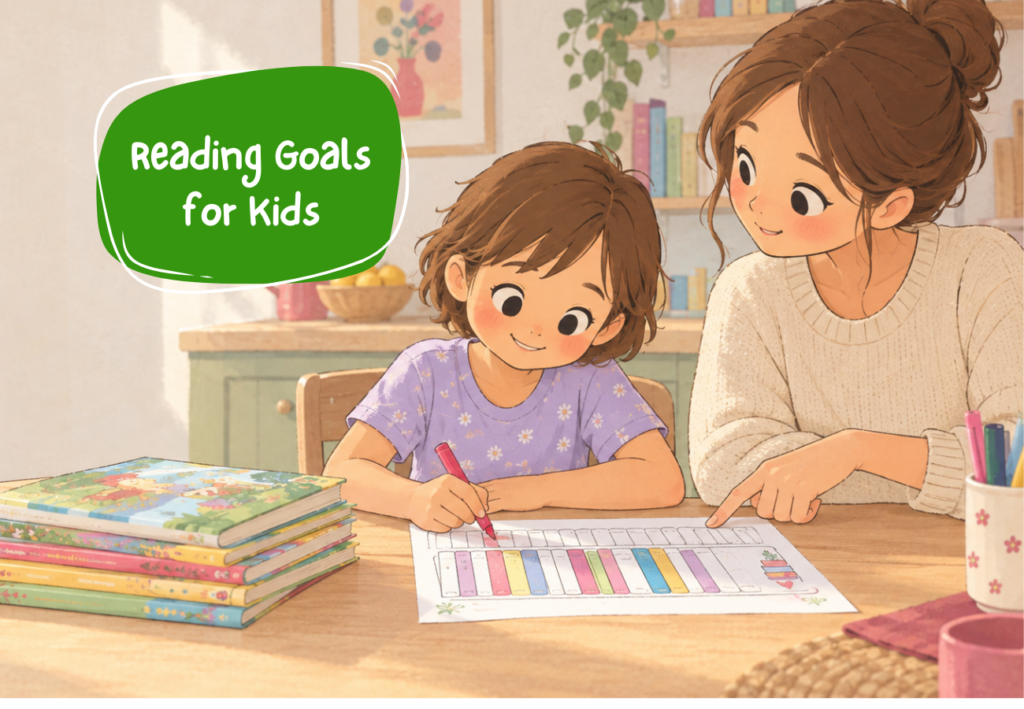
“Read more” is the most common reading advice a child hears, and the least useful. It has no starting point, no finish line and no moment where anyone gets to say “you did it.” A reading goal fixes that. It turns a vague wish into something a child can picture, count and celebrate.
This guide gives you 50 reading goals and challenges you can use tonight: SMART goal examples, goals by age from preschool to upper elementary, classroom-friendly challenge ideas and a free printable reading goals chart to track it all.
What are reading goals for kids?
Reading goals for kids are specific, achievable targets that help children build a reading habit, such as reading 15 minutes a day, finishing 25 books in a year or trying 10 new genres. Good reading goals are short-term, measurable and matched to the child’s age and reading level, so every child can see their progress and celebrate it.
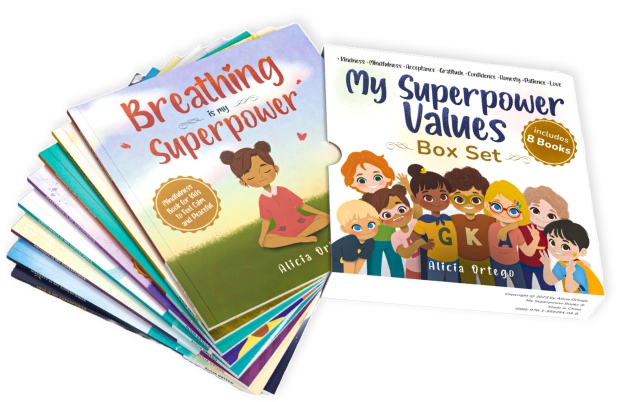
Starting a new reading goal this week? I Can Enjoy Reading! by Alicia Ortego follows a young reader who discovers that books can be fun, which makes it a natural “book number one” on any goal list. You can grab trackers and charts in our free printables collection.
Why Reading Goals Matter
Reading goals matter because children read more when they can see where they are going. A goal gives a reader a target, a way to measure progress and a reason to keep going on the days when a cartoon looks more tempting than a chapter book.
Benefits
The benefits of a reading habit are well documented: stronger comprehension, a bigger vocabulary, better writing and more background knowledge for every school subject. Goals are simply the tool that turns occasional reading into a habit. A child who reads 15 minutes a day reads roughly 90 hours a year, which is enough for dozens of picture books or several long chapter books.
Motivation
A concrete target, such as “finish five books by the end of the month,” feels doable in a way that “read every day” does not. Kids are far more likely to start something when they can picture the finish line. Each book colored in on a chart is a small, visible win that pulls them toward the next one.
Confidence
Every goal a child reaches teaches them that they can set out to do something and follow through. This matters most for struggling and reluctant readers. A small goal they hit builds more confidence than a big goal they miss, so start smaller than you think.
Reading stamina
Reading stamina is the ability to stay focused on a book for a stretch of time. It grows like physical stamina: little by little. A first grader who starts at 5 minutes and adds a minute each week can comfortably read for 20 minutes by spring. Time-based goals are the simplest way to build it.
Vocabulary
Books contain more rare words than everyday conversation or children’s TV. Goals that push variety, such as new genres, nonfiction or read-alouds slightly above a child’s level, expose kids to words they would rarely hear otherwise. Reading aloud together matters here too, because children understand harder words when they hear them than when they decode them alone.
SMART Reading Goals for Kids
The best reading goals are SMART: Specific, Measurable, Achievable, Relevant and Time-bound. “Read more” fails every one of those tests. “Read 15 minutes after dinner every school night this month” passes all five.
Here is how to turn a vague wish into a SMART goal:
| Vague goal | SMART version |
|---|---|
| Read more | Read 15 minutes every day before bed for 4 weeks |
| Read lots of books | Read 25 books by December 31 |
| Read different things | Try 10 different genres this school year |
| Learn about the world | Read one nonfiction book every week this term |
| Read better out loud | Read aloud to a parent or sibling twice a week |
These five work for almost any child, so they are goals 1 to 5 on our list:
- Read 15 minutes every day. The classic habit goal. Use a timer so the child, not the adult, decides when time is up. Younger kids can start at 10 minutes.
- Read 25 books this year. About one book every two weeks. Picture books, graphic novels and audiobooks all count. For early chapter-book readers, 25 is ambitious but realistic.
- Try 10 different genres. Mystery, fantasy, poetry, biography, humor, science, adventure, fairy tales, graphic novels, historical fiction. Variety prevents burnout and often uncovers a new favorite.
- Read one nonfiction book weekly. Many kids, especially reluctant readers, prefer facts to stories. Animals, space, sports and how-things-work books count.
- Read aloud twice a week. Reading aloud builds fluency and expression. The audience can be a parent, a younger sibling, a grandparent on a video call or the family dog.
Tip: Let the child help write the goal. A goal they chose is a goal they own. Your job is to make sure it is small enough to reach.
Reading Goals by Age
The right reading goal depends less on a child’s age than on where they are as a reader. Use these as starting points and adjust up or down. Goals 6 to 23 are grouped by stage.
| Stage | Daily reading time | Realistic book goal | Main focus |
|---|---|---|---|
| Preschool (3–4) | 10–15 min, read aloud by an adult | 3–5 picture books a week | Love of books, listening |
| Kindergarten (5–6) | 10–15 min | 2–4 picture books a week | Letter sounds, sight words |
| 1st grade (6–7) | 15–20 min | 1–3 easy readers a week | Decoding, early fluency |
| 2nd grade (7–8) | 20 min | 2–4 early chapter books a month | Fluency, stamina |
| 3rd grade (8–9) | 20–30 min | 2–3 chapter books a month | Comprehension, independence |
| Upper elementary (9–11) | 30 min | 1–3 novels a month | Variety, deeper thinking |
Preschool reading goals
- Listen to three picture books a day (bedtime counts).
- Point to and name pictures on every page of a favorite book.
- “Read” a familiar book to a stuffed animal by retelling it from the pictures.
Kindergarten reading goals
- Learn five new sight words a week and spot them in books.
- Read one easy book aloud to a grown-up every day.
- Retell a story in the right order: beginning, middle and end.
1st grade reading goals
- Read independently for 15 minutes a day, with a timer.
- Finish 50 easy readers this school year.
- Write or draw one sentence about every book finished in a reading log.
2nd grade reading goals
- Read the first book of a series, then decide whether to keep going.
- Reread a favorite book to read it more smoothly and with expression.
- Read 20 minutes a day, five days a week.
3rd grade reading goals
- Finish one chapter book every two weeks.
- Keep a reading tracker with title, pages and a star rating.
- Recommend one book a month to a friend or classmate.
Upper elementary reading goals (4th–5th grade)
- Read 1,000 pages a semester and log them.
- Read one book from a genre you have never tried each month.
- Read a book, then watch the movie version and compare them.
These are reading milestones, not deadlines. If a goal causes tears, it is too big. Shrink it and let the child succeed first.
Reading Challenge Ideas
A reading challenge for kids is a goal with a game wrapped around it. Challenges work well for classrooms, libraries and siblings because everyone can play at their own level. Ideas 24 to 50 are below, grouped by type.
Book Bingo
Book Bingo is a 5×5 grid where each square is a reading task. Kids mark a square when they complete it and aim for a line, then a full card.
- Classic Book Bingo: squares such as “a book with an animal on the cover,” “a book set in another country,” “a book recommended by a friend.”
- Where-you-read Bingo: read in a blanket fort, under a tree, in the car, by flashlight, in the bath (picture books only).
- Who-you-read-with Bingo: a grandparent, a sibling, a pet, a teacher, on a video call.
Summer Reading
Summer reading challenges help prevent the “summer slide,” the reading loss many kids experience during long school breaks.
- 20 books by back-to-school: about two books a week over a 10-week break.
- Join the public library’s summer program and use its log alongside your own.
- Beach-bag book club: one book per trip, read at the pool, park or beach.
- Summer reading streak: read at least 10 minutes every day and track the longest streak.
100 Books Challenge
The 100 Books Challenge suits kindergarten to 2nd grade, where picture books and easy readers are short enough to make 100 realistic in a school year.
- 100 books before 1st grade: perfect for kindergarteners and parents reading aloud.
- 100 nights of reading: count nights, not books, for older kids reading long novels.
- Class 100 Books Wall: each finished book adds a paper leaf, scale or brick to a classroom display.
Alphabet Reading
Alphabet Reading gives kids 26 mini-goals, one per letter.
- A-to-Z titles: read a book whose title starts with each letter.
- A-to-Z authors: harder, and a great way to discover new writers.
- A-to-Z topics: Animals, Bugs, Castles, Dinosaurs and so on, ideal for nonfiction lovers.
Genre Challenge
A genre challenge pushes kids gently outside their comfort zone.
- Genre passport: a stamp for each of 10 genres.
- Genre of the month: the whole family reads mysteries in October, poetry in April and so on.
- Mood challenge: a funny book, a scary book, a sad book and a book that teaches something.
- Format challenge: a picture book, a graphic novel, a chapter book, an audiobook, a magazine and a cookbook.
Read Around the World
Kids “travel” by reading books set in or written about other countries.
- Seven-continent challenge: one book set on every continent, Antarctica included.
- Map pins: pin a world map for every country visited through a book.
- Read in another language: try a bilingual picture book or a familiar story in a language your family is learning.
- Folktales around the world: compare versions of the same tale from different cultures.
More reading challenges for kids
- Reading Olympics: gold, silver and bronze levels for minutes read, so every child can earn a medal.
- Page race: the class tries to read enough pages to reach the height of the school building.
- Read the series: finish an entire book series start to end.
- Kid’s choice, grown-up’s choice: alternate who picks the next book.
- Reading streak: read at least a few pages every day for 30 days.
- Family Reading Night: finish the challenge with a celebration. Our Family Reading Night ideas guide has 40 activities to plan one.
Printable Reading Goals Chart
A reading goals chart makes progress visible, and visible progress is what keeps kids going. Our free printable has three parts on one page:
- My reading goal: a space for the child to write or draw their goal in their own words.
- Reading tracker: 25 book spines to color in, one per finished book.
- Reading log: columns for date, title, minutes read and a 1–5 star rating.
Print it, stick it on the fridge or a classroom wall, and let the child do the coloring. A reading log the child fills in is far more motivating than one a parent fills in for them.
Download the free Reading Goals Chart (PDF)
How Parents Can Help
The single biggest factor in whether a child reaches a reading goal is the adult beside them. You do not need to be a teacher. You need a routine, access to books and visible enthusiasm.
Reading routines
Attach reading to something that already happens every day: after breakfast, after homework or right before lights out. A fixed time removes the daily negotiation. Keep books where kids naturally are, such as a basket by the sofa, a shelf in the car or a book in the bathroom.
Library visits
A weekly or biweekly library trip gives children a constant supply of free, new books and lets them choose for themselves. Choice is one of the strongest drivers of reading motivation. Let them pick at least one book purely for fun, even if it is “too easy” or a comic.
Model reading
Children copy what they see. If they see you reading a book, a magazine or a recipe, reading becomes normal family behavior rather than homework. Try a family quiet-reading time where everyone, adults included, reads for 20 minutes with phones away.
Celebrate milestones
Notice every milestone out loud: the first chapter book, the 10th book on the chart, a full Bingo card. Celebrations do not need to be big. A note in the lunchbox, a phone call to grandma or choosing the next family read-aloud can mean more than a toy.
Reading Goal Rewards
Rewards can give a reading goal an exciting finish line, but the best ones keep the focus on books. A new book, a trip to the bookstore, an extra bedtime story or a reading picnic all celebrate the goal while pointing kids back toward reading.
Rewards that have nothing to do with reading, such as candy or money, can teach children that reading is a chore they get paid to do. Use rewards for milestones, not for every page, and fade them out as the habit takes hold.
For 50 ideas that actually work at home and in the classroom, see our guide to reading rewards ideas.
FAQs
How many books should a child read?
There is no single right number. As a rough guide, preschoolers and kindergarteners can enjoy 3–5 picture books a week, early readers 1–3 easy readers a week and upper elementary kids 1–3 chapter books a month. Time spent reading matters more than the book count.
How long should kids read daily?
Most teachers recommend about 15–20 minutes a day for younger children and 20–30 minutes for upper elementary students. Being read to counts, especially for preschoolers. Consistency every day beats one long session on the weekend.
What are realistic reading goals?
Realistic reading goals are small, specific and slightly above what the child already does. If your child reads 5 minutes now, aim for 10, not 30. A good test: the child should be able to hit the goal on an ordinary, busy day.
Should children track books?
Yes, as long as it stays light. A simple reading tracker or log helps kids see their progress and remember what they enjoyed. Keep it to a title and a star rating for younger kids. Long written summaries can make reading feel like homework.
What is a reading milestone?
A reading milestone is a moment that marks real progress, such as finishing a first chapter book, reading 20 minutes without a break or completing 25 books. Milestones are a natural time for a small celebration.
What are good reading goals for elementary students?
Good reading goals for elementary students combine habit and variety: read 20 minutes a day, finish one book every two weeks, try a new genre each month and keep a simple reading log.
Do audiobooks count toward reading goals?
Yes. Audiobooks build vocabulary, comprehension and a love of stories. Many families count them fully, and some use a different color on the chart to keep a balance with print books.
What if my child does not meet their reading goal?
Treat it as information, not failure. Make the goal smaller, let the child choose more of the books and check that the books are at the right level. The aim is a child who wants to read, not a perfect chart.
Start Your Child’s Reading Goal Today
The best reading goal is the one your child is excited to start this week. Pick one idea from this list, print the chart and choose the first book together.
Need milestone books? Alicia Ortego’s My Superpower books are short, rhyming picture books about positivity, good choices, perseverance and listening, so they are easy wins for young readers and great read-alouds for the whole family. Many parents use each new title as a milestone: finish five books, earn the next Superpower story. Start with I Can Enjoy Reading!, a story about a child who discovers that reading is fun.
For more ideas, read our guides to reading rewards and Family Reading Night, and download the free printables.
More articles
50 Creative Reading Rewards Ideas That Motivate Kids to Love Books
Every parent and teacher of a reluctant reader has wondered the same thing: should I reward my child for reading? If rewards are done badly, they turn books into a chore you get paid for. However, when they are done well, they give kids the push they need until reading becomes its own reward. This […]
Top Math Apps for Kids: A Practical 2026 Guide for Parents and Educators
Finding a good math app for your child sounds simple until you actually start looking. Some apps are little more than worksheets dressed up with cartoons and rewards. Others are entertaining games where the educational part feels like an afterthought. The best math apps for kids sit somewhere in the middle: children genuinely want to […]
The Calm, Prepared Parent: Why CPR Training Belongs Beside Emotional Intelligence Lessons
My daughter once told me her feelings were “too big for her body.” She was four, fresh off a picture book that teaches kids to name what they feel instead of melting down. It’s a lovely lesson for parents, teachers, and daycare providers to pass along. But here’s the question that stopped me cold: if […]